Iconic Musicians Who Shaped the Alternative Hip-Hop Scene
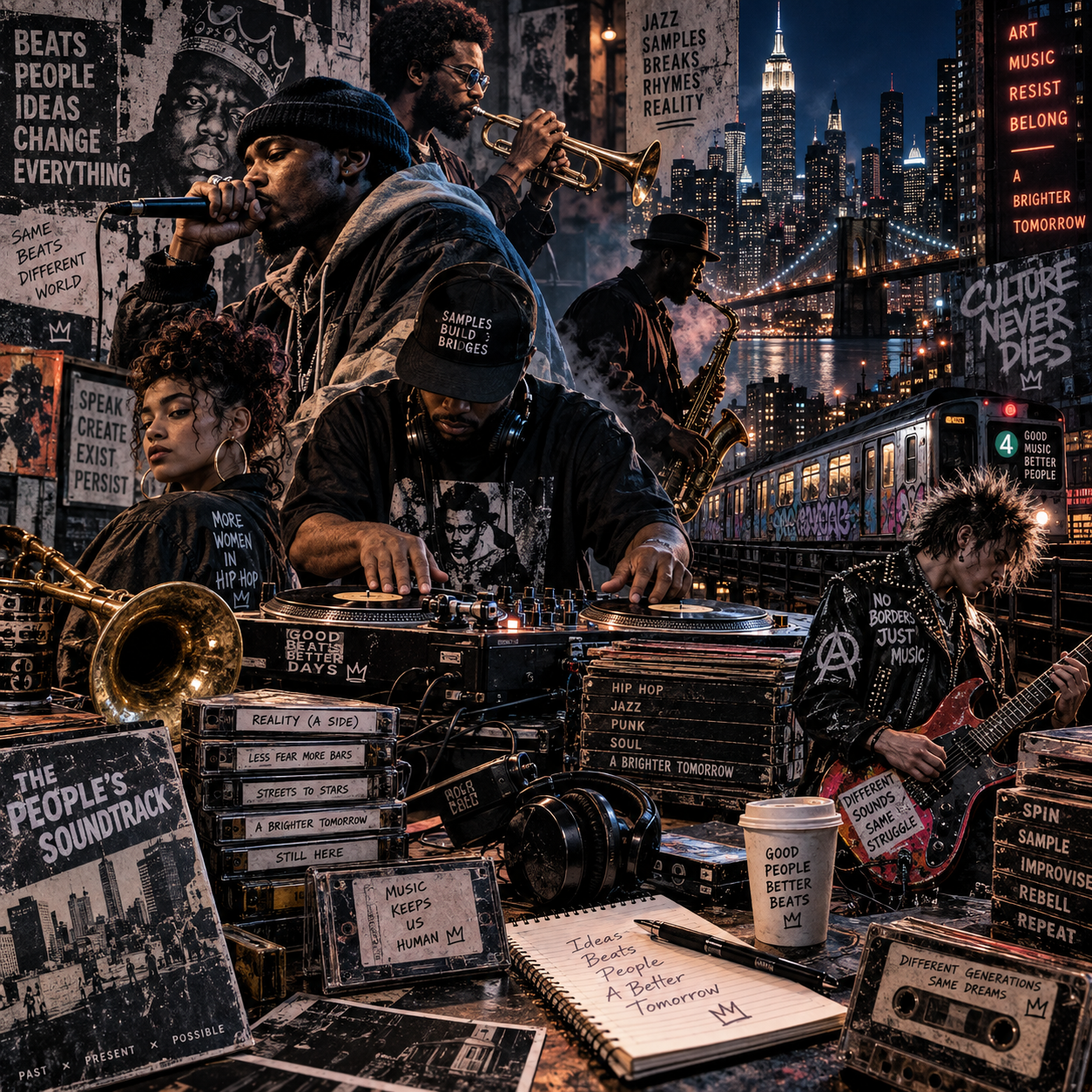
Alternative hip-hop has always been more of a creative territory than a strict genre. Its artists question familiar rap formulas, bend production rules, and pull ideas from jazz, rock, punk, soul, electronic music, and avant-garde composition. The result can be melodic or abrasive, political or surreal, sample-heavy or almost entirely live.
From the Native Tongues collective to independent producers working in bedrooms and small studios, these musicians expanded what hip-hop could sound like and who it could speak to. Their influence can be heard across underground hip-hop, conscious hip-hop, jazz rap, experimental hip-hop, and today’s genre-fluid independent music.
What Defines Alternative Hip-Hop?
Alternative hip-hop is rap that deliberately explores unusual sounds, structures, subjects, and production methods beyond dominant commercial formulas. It often overlaps with underground hip-hop, conscious hip-hop, jazz rap, and experimental hip-hop, but none of those labels fully contains it.
The scene is best understood through four connected ideas: experimentation, genre fusion, independence, and artistic control. An alternative rapper might use a fragmented drum pattern, an unexpected time signature, live bass, distorted guitar, or a spoken-word arrangement. Another might keep traditional beats while using abstract lyrics and unconventional song structures.
Independence also matters. Many influential artists built audiences through college radio, touring, mixtapes, small labels, vinyl releases, and DIY music culture rather than relying on major-label marketing. That route can limit budgets and reach, yet it gives musicians room to take risks that a tightly tested pop formula may reject.
There is no single sound. A useful test is to ask three questions: Does the music challenge an expectation? Does it connect hip-hop to another creative language? Does the artist retain a strong sense of authorship? When the answer is yes, the work often belongs somewhere in the alternative hip-hop conversation.
Early Innovators and the Foundations of the Scene
Early alternative hip-hop grew from artists who treated rap as an open musical form, using inventive sampling, unusual voices, dense writing, and collaborative production to expand its vocabulary.
De La Soul helped establish a playful, colorful alternative to hardened rap stereotypes. Their debut album, 3 Feet High and Rising, paired surreal humor and conversational chemistry with eclectic samples and imaginative arrangements. The group showed that eccentricity could be a source of authority.
A Tribe Called Quest made jazz-informed rap feel effortless. Q-Tip’s understated delivery, Phife Dawg’s sharper energy, and Ali Shaheed Muhammad’s production created a balance between groove and reflection. Albums such as The Low End Theory demonstrated how bass, drum breaks, and sampled jazz could support both lyrical intimacy and social observation.
On the more confrontational side, Public Enemy turned dense production into a form of political pressure. The Bomb Squad’s layered samples, sirens, noise, and abrupt edits gave Chuck D and Flavor Flav a chaotic sonic environment that matched the group’s urgent writing. Their work proved that rap production could function like sound collage rather than a simple backing track.
Meanwhile, Prince Paul helped redefine the producer’s role. Through projects connected to De La Soul, Gravediggaz, and Handsome Boy Modeling School, he treated sequencing, character voices, skits, and tonal shifts as part of the composition. That approach influenced later musicians who viewed an album as a complete world instead of a collection of isolated singles.
The Native Tongues and the Rise of Jazz-Inflected Rap
Native Tongues artists shaped jazz rap by combining playful lyricism, communal collaboration, socially aware writing, and samples drawn from jazz, funk, soul, and Afrocentric musical traditions.
The Native Tongues network included De La Soul, A Tribe Called Quest, Jungle Brothers, Queen Latifah, and associated collaborators. It was not a single sound or formal school. Its importance came from the way artists shared ideas, appeared on one another’s records, and presented intelligence, humor, style, and community as strengths.
Jungle Brothers connected house music, funk, and rap while maintaining a welcoming, rhythmic feel. Queen Latifah brought commanding delivery and a clear social perspective, challenging narrow assumptions about who could lead a hip-hop record. Their contributions helped make alternative rap feel expansive rather than merely oppositional.
Jazz rap’s influence also came from its treatment of space. Instead of filling every moment with aggressive drums, producers allowed bass lines, horn phrases, percussion, and silence to shape the groove. That restraint encouraged MCs to focus on cadence, internal rhyme, storytelling, and conversational detail.
The collective model remains valuable for musicians today. Collaboration can create a stronger identity than isolated branding, especially when artists share producers, visual language, local venues, and audiences. The trade-off is that scenes are difficult to preserve: once a sound becomes commercially recognizable, its original looseness can become a market category.
Artists Who Connected Hip-Hop With Rock, Punk, and Alternative Music
Artists who connected hip-hop with rock and punk expanded the music through live instrumentation, abrasive textures, rebellious performance styles, and a willingness to treat genre boundaries as optional.
Beastie Boys moved from punk energy into sample-driven hip-hop without losing their sense of irreverence. Their records drew from hard rock, funk, soul, and turntablism, while their performances emphasized movement and personality. Paul’s Boutique, produced with the Dust Brothers, became a landmark in densely layered sampling and creative arrangement.
Rage Against the Machine was not an alternative hip-hop group in the narrow sense, but their fusion of rap cadence, metal guitar, funk rhythm, and political confrontation influenced the broader rap-rock conversation. Tom Morello’s effects-heavy guitar often behaved like a DJ or sampler, producing scratches, sirens, and electronic textures from a live instrument.
Linkin Park later brought turntables, programmed production, metal guitars, rap verses, and melodic vocals to a massive audience. Their scale was different from underground hip-hop, yet their hybrid approach showed how alternative ideas could travel through mainstream channels without disappearing entirely.
Artists such as cLOUDDEAD pushed the connection into stranger territory. Their abstract vocals, fractured beats, and unsettling atmospheres treated rap like experimental sound art. This path appealed to listeners who valued texture and emotional ambiguity over conventional hooks.
Genre fusion works best when each ingredient has a structural purpose. Adding a guitar does not automatically create meaningful rap-rock; the guitar should alter rhythm, mood, performance, or arrangement. That distinction separates genuine musical conversation from decorative crossover.
Experimental Production and Independent Artistic Control
Experimental hip-hop grew through producers and artists who used unconventional samples, electronic sounds, abstract structures, and independent release strategies to protect their creative choices.
DJ Shadow showed how an instrumental hip-hop album could carry narrative weight. His landmark release Endtroducing..... assembled obscure samples, breakbeats, ambient passages, and cinematic transitions into a carefully sequenced journey. The record made the producer’s editing and arrangement feel like the central performance.
J Dilla changed beat-making through deliberately imperfect timing, unusual swing, chopped samples, and emotionally rich loops. His work with Slum Village, A Tribe Called Quest, Common, and many others influenced producers across jazz rap, neo-soul, electronic music, and contemporary alternative rap. The lesson was practical: a beat can feel more human when it does not sit perfectly on the grid.
MF DOOM combined dense internal rhymes, comic-book imagery, obscure samples, and unconventional song structures. Across projects such as Madvillainy with Madlib, he made mystery, character, and lyrical compression central to the listening experience. Madlib, meanwhile, moved fluidly between jazz-inspired production, dusty loops, electronic experiments, and imaginary alter egos.
Flying Lotus brought a producer’s interest in electronic sound design, irregular rhythms, and free-form structure into hip-hop-adjacent music. Death Grips pushed intensity through industrial electronics, punk confrontation, and distorted vocal performance. These artists demonstrate how independent music can turn limitations into an aesthetic: cheaper tools, smaller teams, and direct distribution can encourage sharper decisions.
For musicians building their own practice, the useful framework is source, transform, and frame. Choose an interesting source, transform it through rhythm or texture, then frame it with sequencing and context. The strongest DIY records usually make all three stages audible.
Lasting Influence on Today’s Musicians
The lasting influence of alternative hip-hop appears in today’s genre-fluid production, independent rap communities, live-band arrangements, and musician-led release models.
Contemporary artists often move between rap, R&B, jazz, electronic music, punk, and ambient sound within a single project. Tyler, the Creator uses orchestration, soul, jazz harmony, and carefully designed album worlds. Earl Sweatshirt carries forward abstract lyricism and fragmented sample-based production. Little Simz combines rap with orchestral scale, soul, and introspective storytelling.
Artists such as JPEGMAFIA use distortion, industrial noise, pop references, and deliberately unstable arrangements to create a modern form of experimental hip-hop. Arca and clipping. show how electronic composition, sound design, and conceptual performance can reshape the relationship between rapper, producer, and listener.
The influence is also organizational. Independent artists now use digital distribution, direct-to-fan platforms, home recording, short-form video, and community-based promotion to reach listeners without waiting for traditional gatekeepers. Access is broader, but attention is more fragmented. Creative control has increased while sustainable income remains difficult.
That tension defines the current moment. Alternative hip-hop’s central idea survives whenever musicians choose a distinctive process over an obvious template and build an audience around the details that make their work difficult to imitate.
Where to Start: Essential Listening Paths
The best way to explore alternative hip-hop is to follow a listening path based on sound, then move outward through related artists and collaborators.
- For jazz rap: Begin with A Tribe Called Quest’s The Low End Theory, then try Gang Starr’s Daily Operation and Digable Planets’ Reachin’ (A New Refutation of Time and Space). Listen for bass placement, relaxed drums, and the conversation between samples and vocals.
- For playful, communal alternative rap: Start with De La Soul’s 3 Feet High and Rising and Queen Latifah’s All Hail the Queen. These records highlight humor, personality, social awareness, and the creative energy of the Native Tongues era.
- For political intensity: Hear Public Enemy’s It Takes a Nation of Millions to Hold Us Back. Focus on how the Bomb Squad layers noise, rhythm, and vocal fragments into a deliberately pressurized mix.
- For sample-based production: Try DJ Shadow’s Endtroducing..... and J Dilla’s Donuts. These albums are useful studies in sequencing, repetition, imperfection, and emotional storytelling without conventional rap structures.
- For abstract lyricism: Explore MF DOOM and Madlib’s Madvillainy, then listen to Earl Sweatshirt’s Some Rap Songs. Notice how compression, unusual phrasing, and unfinished-feeling loops can create atmosphere.
- For rock and punk crossover: Compare the Beastie Boys’ Paul’s Boutique, Rage Against the Machine’s self-titled album, and Death Grips’ The Money Store. The comparison reveals three very different approaches to aggression, live energy, and genre fusion.
Do not treat this list as a ranking. Alternative hip-hop rewards comparison: hear how one artist uses a sample, drum pattern, vocal tone, or album sequence, then trace that technique into another scene. Credits are especially revealing because producers, engineers, DJs, and guest musicians often connect records that seem unrelated at first.
Frequently Asked Questions About Alternative Hip-Hop
What is alternative hip-hop?
Alternative hip-hop is rap that explores unconventional production, lyricism, performance, or genre combinations. It may include jazz rap, experimental hip-hop, conscious hip-hop, underground hip-hop, and independent music, but it is defined by creative approach rather than one fixed sound.
Which musicians helped pioneer alternative hip-hop?
Important pioneers include De La Soul, A Tribe Called Quest, Public Enemy, Queen Latifah, Beastie Boys, Prince Paul, DJ Shadow, and early Native Tongues collaborators. Their contributions ranged from jazz-based sampling and political production to playful writing and producer-led album design.
How is alternative hip-hop different from mainstream rap?
The main difference is emphasis. Mainstream rap often prioritizes broad accessibility and established commercial structures, while alternative hip-hop gives more space to unusual sounds, abstract themes, independent methods, and genre fusion. The categories overlap, and a musician can work in both spaces.
Which genres influenced alternative hip-hop?
Jazz, funk, soul, rock, punk, electronic music, house, metal, spoken word, and experimental composition all influenced alternative hip-hop. Sampling culture made these connections especially fluid, allowing producers to place different musical histories inside a new rhythmic framework.
Where should a new listener begin?
Start with The Low End Theory for jazz rap, 3 Feet High and Rising for playful alternative hip-hop, It Takes a Nation of Millions to Hold Us Back for political intensity, or Endtroducing..... for instrumental experimentation. Choose the sound that interests you most, then follow its collaborators and producers.